
What to Put on a Fridge Emergency Card (and What to Leave Off)
By the Emergency Info Card Editorial Team
·
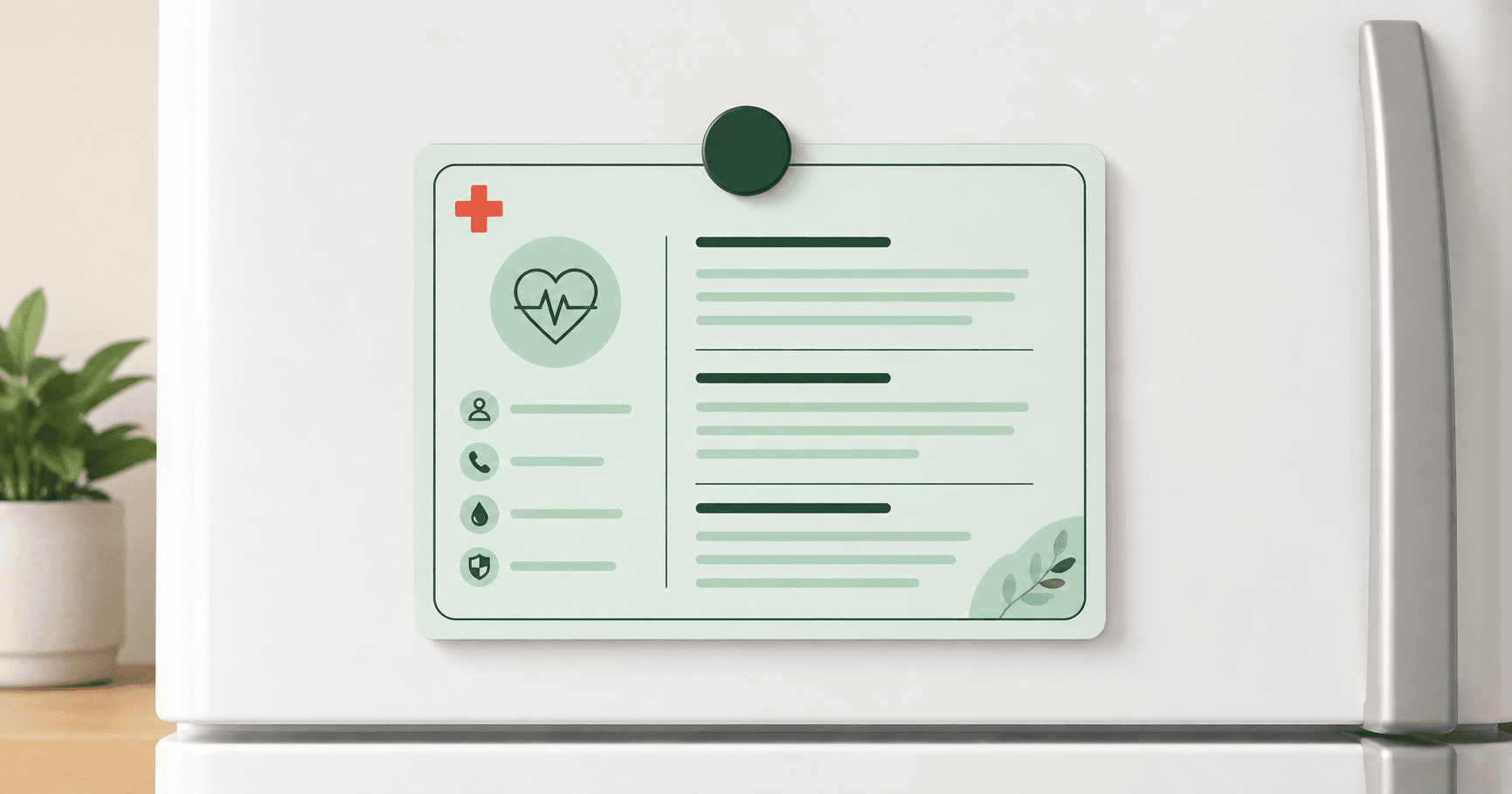
A fridge emergency card should list six things, in this order: your full name and date of birth, your medical conditions, your current medications and doses, your allergies, your emergency contacts, and your doctor and preferred hospital. That order matters because it's roughly the sequence emergency medical services (EMS) work through when they find one — identity first, then what's wrong, then what they must not give you.
The reason the card lives on the refrigerator at all is a decades-old first-responder practice. Under the Vial of Life program (also written "File of Life"), US fire departments and EMS agencies ask residents — especially seniors living alone — to keep a medical-information form in the fridge and a sticker on the front door and fridge to flag it. Responders are trained to check the fridge for it the same way they check a wallet. The fridge is chosen because it's in a predictable spot in almost every home, needs no phone, no password, and no internet. For the history and definition of the program, see our Vial of Life glossary entry.
The six fields to include — and why EMS needs each
- Full name + date of birth. Confirms identity and lets the hospital pull your records. Date of birth also signals age-related risk fast.
- Medical conditions. Diabetes, epilepsy, heart disease, COPD, kidney/dialysis, dementia. This tells responders what emergency they're likely dealing with before you can speak.
- Current medications + doses. Blood thinners (warfarin, apixaban), insulin, beta-blockers, and anti-seizure drugs change how EMS treats you. A blood thinner, for example, changes how they manage bleeding and a head injury — see our blood thinner emergency card guide.
- Allergies. Especially drug allergies (penicillin, sulfa, contrast dye). This is the "do not give" list — it prevents a second emergency in the ambulance.
- Emergency contacts. Two names, relationship, and phone numbers. The people who can consent, share history, and meet you at the hospital.
- Doctor + preferred hospital. Speeds up records and, where possible, routes you to the hospital that already knows you.
What to leave off
Because the card sits in a visible spot, do not put anything on it that helps identity theft more than it helps a paramedic:
- No Social Security number.
- No insurance ID or policy numbers — the hospital collects these later; a paramedic never needs them.
- No home-alarm codes or bank details.
A fridge card is a medical document, not a wallet. Keep it to what saves your life in the first ten minutes.
Where to put it
Store the card on the front of the fridge with a magnet, or in a labeled pouch on the top shelf inside if you prefer it out of sight, and add a small decal near your front door so responders know to look — the fridge sticker and door sticker are exactly what EMS are trained to spot. A 5"-wide card is large enough for a responder to read at arm's length under stress — bigger than a wallet card on purpose.
The fastest way to make one
You can hand-write a Vial of Life form, but the common failure is that it's blank, out of date, or hard to read. The free card generator produces a filled, printable fridge card for you in a few minutes — you type your details once and download a print-ready PDF. It's free, needs no signup, and everything you enter stays in your browser: your medical data never leaves your device and is never uploaded to a server. That last point matters for a document this sensitive — you're not handing your medication list to a website. Print it, stick it on the fridge, and review it whenever a medication changes.
Frequently asked questions
Frequently asked questions
Print your free fridge emergency card
The free card generator creates a wallet-sized and a 5"-wide fridge card from a single set of details, plus a combined letter-sized PDF for extra copies. It takes about three minutes, runs entirely in your browser, and stores nothing on any server. If you also carry a phone, our guide on fridge cards vs phone Medical ID explains why many people keep both.
Sources
We cite primary, authoritative sources. Read our editorial standards for how we research and verify information.
Brevard County Fire Rescue
Vial of Life ProgramMarin County Fire Department (EMS)
Get a Vial of L.I.F.E.