
Epilepsy Emergency Card: What to Put On It So a Stranger Can Act
By the Emergency Info Card Editorial Team
·
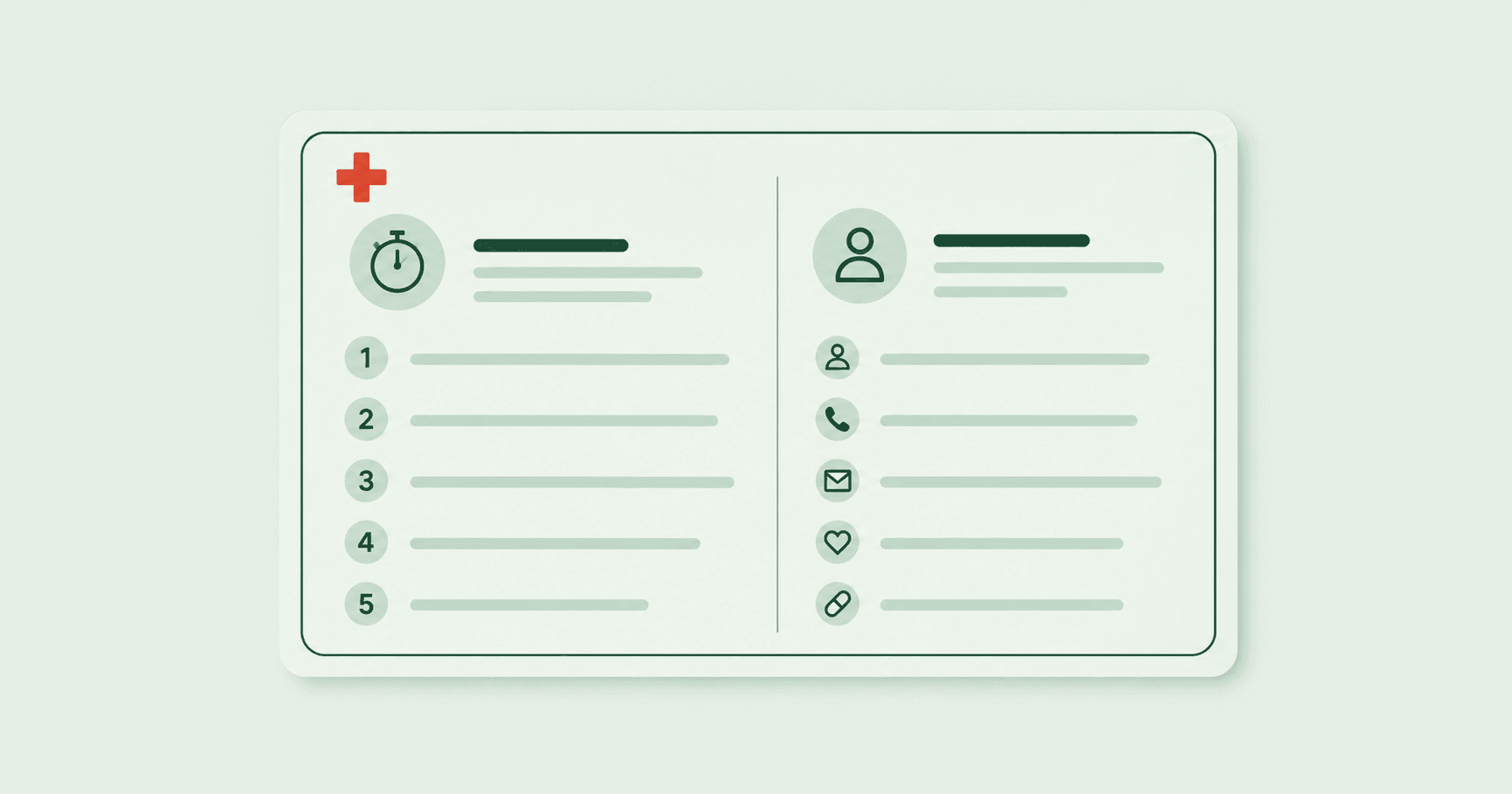
An epilepsy emergency card needs two things a generic medical ID card doesn't: a one-line description of what your usual seizure looks like and how long it lasts, and short instructions telling whoever finds you what to do — above all, that they should call 911 if the seizure passes five minutes, and that they must not restrain you or put anything in your mouth. Your name, medications, and contacts still matter, but for a seizure they are the second half of the card, not the first.
That split is the whole design problem. Most medical cards answer who is this person. A seizure card also has to answer what is happening and what do I do about it, because the person reading it is usually a stranger who has never seen a seizure and is deciding, right then, whether to call an ambulance.
Step one of seizure first aid is "check for medical ID"
The standard US seizure first-aid protocol is Stay, Safe, Side: stay with the person until they are awake and alert, keep them safe from harm, and turn them onto their side if they are not awake and aware. Step 1 spells out three sub-steps — time the seizure, remain calm, and check for medical ID.
That is the moment your card exists for. Not the hospital, not the paramedic handover — the first sixty seconds, when a bystander who has been told to look for a medical ID actually finds one. What the card says next decides what they do.
Three of the seven "call 911" triggers depend on knowing your normal
The same first-aid guidance lists seven reasons to call 911 during a seizure. Read them as a stranger would:
| Call 911 if… | Can a stranger judge it? |
|---|---|
| Seizure lasts longer than 5 minutes | Yes — they can see or time it |
| Repeated seizures | Not without knowing you |
| Person does not return to their usual state | Not without knowing you |
| First-time seizure | Not without knowing you |
| Person is injured, pregnant, or sick | Yes — they can see or time it |
| Difficulty breathing | Yes — they can see or time it |
| Seizure occurs in water | Yes — they can see or time it |
Injury, pregnancy, breathing trouble and water they can see. The five-minute rule they can time, if someone thought to start timing. But "repeated seizures", "does not return to their usual state", and "first-time seizure" are unanswerable without you. A bystander has no idea whether twenty minutes of confusion is your normal recovery or a deteriorating emergency, and no idea whether this is your first seizure or your four-hundredth. Those three of the seven criteria are exactly the gap a card can close — and exactly what a card that only lists your name, allergies, and medications leaves open.
So the highest-value line on an epilepsy card is not a diagnosis. It is a baseline: this is what my seizure normally looks like, this is how long it normally lasts, this is how long I am normally confused afterward.
What to put on an epilepsy emergency card
Field by field, in the order a finder needs them:
- The instruction block, first and largest. "I have epilepsy. This is a seizure. Do not restrain me. Do not put anything in my mouth. Turn me on my side. Time it — call 911 if it lasts more than 5 minutes." Both "do not"s come straight from the national first-aid flier, and both are things untrained bystanders still get wrong.
- Your usual seizure, in one line. Type if you know it (focal with impaired awareness, tonic-clonic, absence), what it looks like, and typical duration. "Usually 60–90 seconds" tells a bystander when to worry — and when not to.
- Your usual recovery. How long you are confused, and how you behave. The postictal period — the stretch between the seizure ending and your return to baseline — typically lasts between 5 and 30 minutes and brings confusion, drowsiness, headache and nausea. A line saying "confused and unsteady for up to 30 minutes afterward — this is normal for me, I am not intoxicated" does two jobs: it stops an unnecessary ambulance, and it heads off the far worse misreading of postictal confusion as drunkenness.
- Rescue medication, if you have one — name, dose, route, and when to give it. See the next section.
- VNS magnet, if you have an implant — and where the magnet is kept.
- Daily anti-seizure medications. Levetiracetam, lamotrigine, valproate, carbamazepine and the rest matter to the hospital, not to the bystander, so they sit below the instruction block.
- Allergies, drug allergies especially. This is the "do not give me this" line.
- Two emergency contacts, with relationship and phone number, plus your neurologist or epilepsy clinic. For a seizure disorder the neurologist is often more useful than a primary-care name.
Everything above the daily-medication line is for the stranger. Everything below it is for the hospital. Design the card in that order and it works for both. The general version of this checklist — the fields every card needs regardless of condition — is in what to put on a medical ID card.
Rescue medication and VNS: the two lines only you can write
If you have been prescribed a rescue medication for seizure clusters, the card should carry its exact instruction, because the person holding it will not improvise. Nasal midazolam (Nayzilam), for example, is labelled for "the acute treatment of intermittent, stereotypic episodes of frequent seizure activity (i.e., seizure clusters, acute repetitive seizures) that are distinct from a patient's usual seizure pattern" in patients 12 and older, and its label allows one additional 5 mg spray in the opposite nostril after 10 minutes if there is no response, with no more than two doses per episode. Diazepam formulations differ. Write your own prescriber's wording on the card, not a generic version — and note that the first-aid flier's "do not" list has an explicit exception: rescue medicines can be given if prescribed by a health care professional.
If you have a vagus nerve stimulator, the magnet is useless to a bystander who doesn't know it exists. Guidance written for school nurses describes the swipe plainly: pass the magnet over the device from the center of the body toward the armpit, taking about three seconds, at the first sign of a seizure; if the seizure continues you may swipe again after 60 seconds. Two short lines — VNS implanted, left chest. Magnet in front pocket of bag: swipe over device toward armpit for 3 seconds — convert a device nobody can see into something a stranger can actually use.
Fitting it on a wallet card: a worked example in 140 characters
Wallet cards are small, and that constraint is where most epilepsy cards fail — people write a paragraph that doesn't fit, or they write "Epilepsy" and stop. On our free card generator the conditions box holds 140 characters, allergies 140, and medications 180. Those numbers are worth planning against whatever tool or template you use, because a wallet card is roughly that size regardless.
Here is 140 characters spent well. This is 133:
Epilepsy, focal seizures w/ impaired awareness. Usually 60-90 sec. Confused 20-30 min after, not drunk. VNS implanted, magnet in bag.
And a tonic-clonic version, 124 characters:
Epilepsy - tonic-clonic. Usually under 2 min. Call 911 if over 5 min. Confused/unsteady up to 30 min after. Do not restrain.
Note what each one spends its budget on: seizure type, typical duration, recovery baseline, and one device or instruction. No history, no medication list (that has its own field), no explanation of what epilepsy is.
Then the medications field carries the rescue drug in your prescriber's words, including their trigger. Copy the trigger rather than inventing one: rescue drugs are labelled for different situations, and nasal midazolam's is seizure clusters distinct from your usual pattern — not one long seizure. A card line like "Rescue: midazolam nasal 5mg - 1 spray for a cluster, 2nd spray other nostril after 10 min. Per [prescriber]." runs 108 characters with a real prescriber's name in place of the bracket — comfortably inside 180, and it names the person who set the instruction.
Write the card in that order and the first thing a stranger reads is the thing that changes what they do.
Two caveats on those limits. First, they're sized for the fridge card, which prints everything; the wallet card shrinks its type as the medical block grows and, if it still doesn't fit, clips the overflow and prints "… (see fridge card)" so nobody assumes they've read the whole list. Second, if you fill all three fields near their caps, the wallet copy is the one that gives. Spend the budget on the lines a bystander acts on and let the rest live on the fridge card.
What to leave off
An emergency card is a medical document, not an identity file. Leave off your Social Security number, insurance or policy numbers, bank details, and alarm codes — a hospital collects insurance later and a paramedic never needs it. The reasoning behind that line, and which fields actually carry fraud risk, is in is it safe to keep medical information in your wallet.
A card is not a seizure action plan
They serve different readers. A seizure action plan is a longer document — often a page — that you agree with your neurologist and hand to a school, employer, or care home, covering triggers, medication schedules, rescue-medication authorisation, and who to notify. An emergency card is the wallet-sized subset a stranger can read in ten seconds without any prior relationship to you. If you have a plan, the card should be its first paragraph, compressed. If you don't, the card is still worth carrying today.
Frequently asked questions
Frequently asked questions
Making one
You can hand-write a card, print a blank template, or buy a designed one — the common failure with all three is the same: it ends up empty, out of date, or too dense to read under stress. The free card generator builds a filled, print-ready wallet card and a matching larger fridge card from details you type once. It's free, there's no signup, and everything you enter stays in your browser — your medical information is never uploaded to a server, which is worth checking before you type a seizure history and a medication list into any website.
Print it, put it behind your ID, and redo it whenever a medication, dose, or seizure pattern changes. A card describing seizures you no longer have is worse than no card at all.
Sources
We cite primary, authoritative sources. Read our editorial standards for how we research and verify information.
Epilepsy Foundation (produced with CDC funding)
Seizure First Aid — Stay, Safe, Side (flier, Rev. 02/2020)StatPearls / NIH National Library of Medicine
Postictal Seizure StateDailyMed / NIH National Library of Medicine
NAYZILAM (midazolam) nasal spray — prescribing informationIowa Department of Education
School Nurse Toolkit — Vagus Nerve Stimulator